Preschool Nepal: Modern Learning Approaches for Young Children
Explore modern Preschool Nepal learning approaches, including play-based learning, creative activities, technology, and early childhood development.
Preschool Nepal: Modern Learning Approaches for Young Children
The early years of a child's life are very important as children become able to do many things during this period in their lives. They gain communication skills, learn more about the world and how to behave around other people.
Preschool education is becoming a very important factor in terms of school education in Nepal. Every parent and educator tries to obtain teaching methods that will enhance not only the children's academic progress but also their creativity, confidence, communication, and social skills. Modern Preschool Nepal is one of the practices that might offer solutions in this regard.
What Do We Mean by Modern Preschool Education?
Modern preschool education is all about the methods of teaching little kids. Instead of using traditional methods like memorisation, preschoolers learn through questions, examining things, solving simple problems, and their experience.
A modern preschool classroom may involve storytelling, puzzles, music, drawing, group activities, and the use of some digital tools. All these methods are appropriate for kids because they enable them to incorporate new information into what they already know.
To illustrate, if they study animals, children can look at pictures of animals, listen to animal sounds, talk about animal habitats, and make drawings of animals.
1. Play-Based Learning
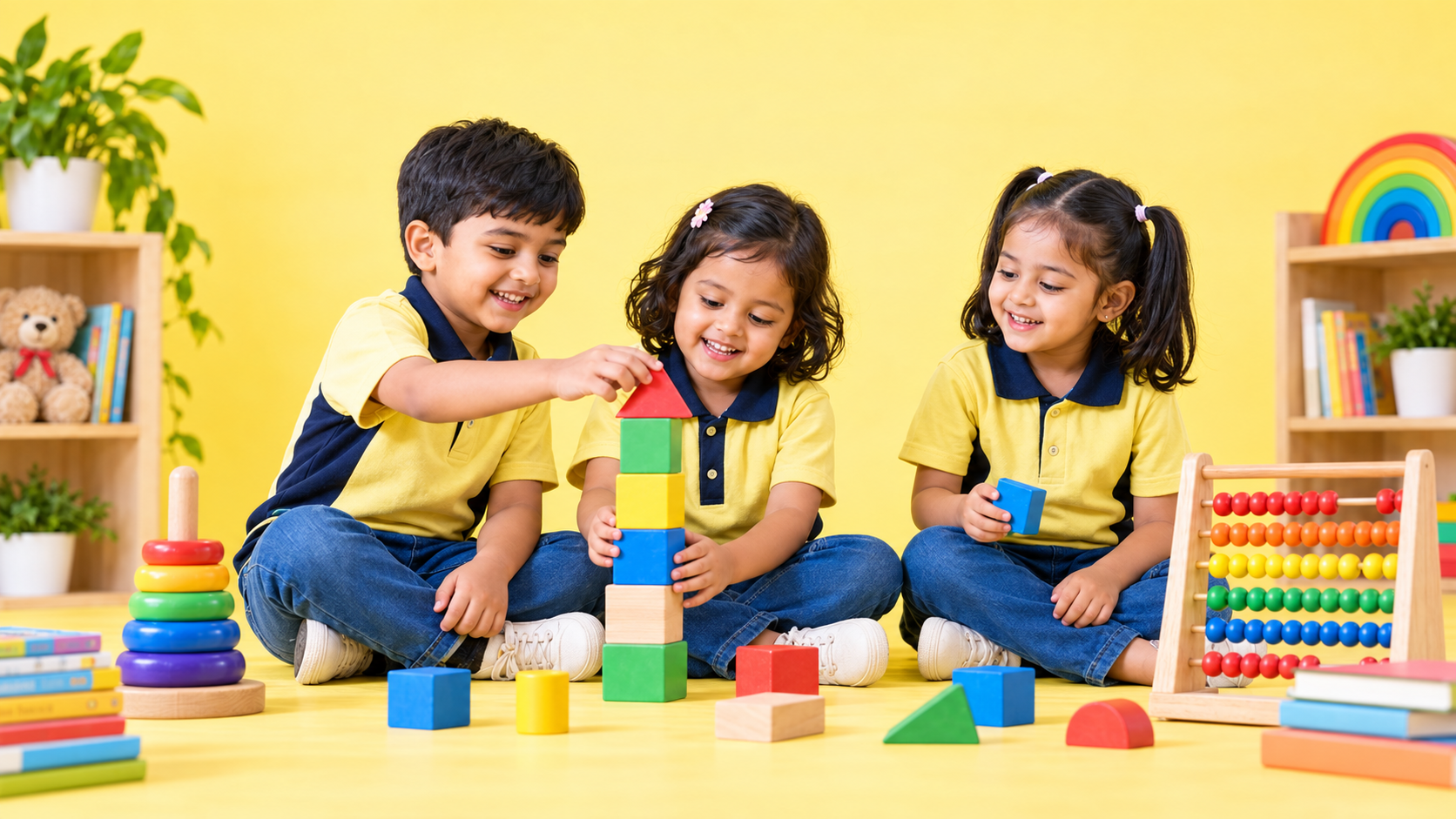
Play-based learning is a very beneficial approach that can be used in early childhood education. Through games, pretend play, construction work, and other hands-on activities, children learn.
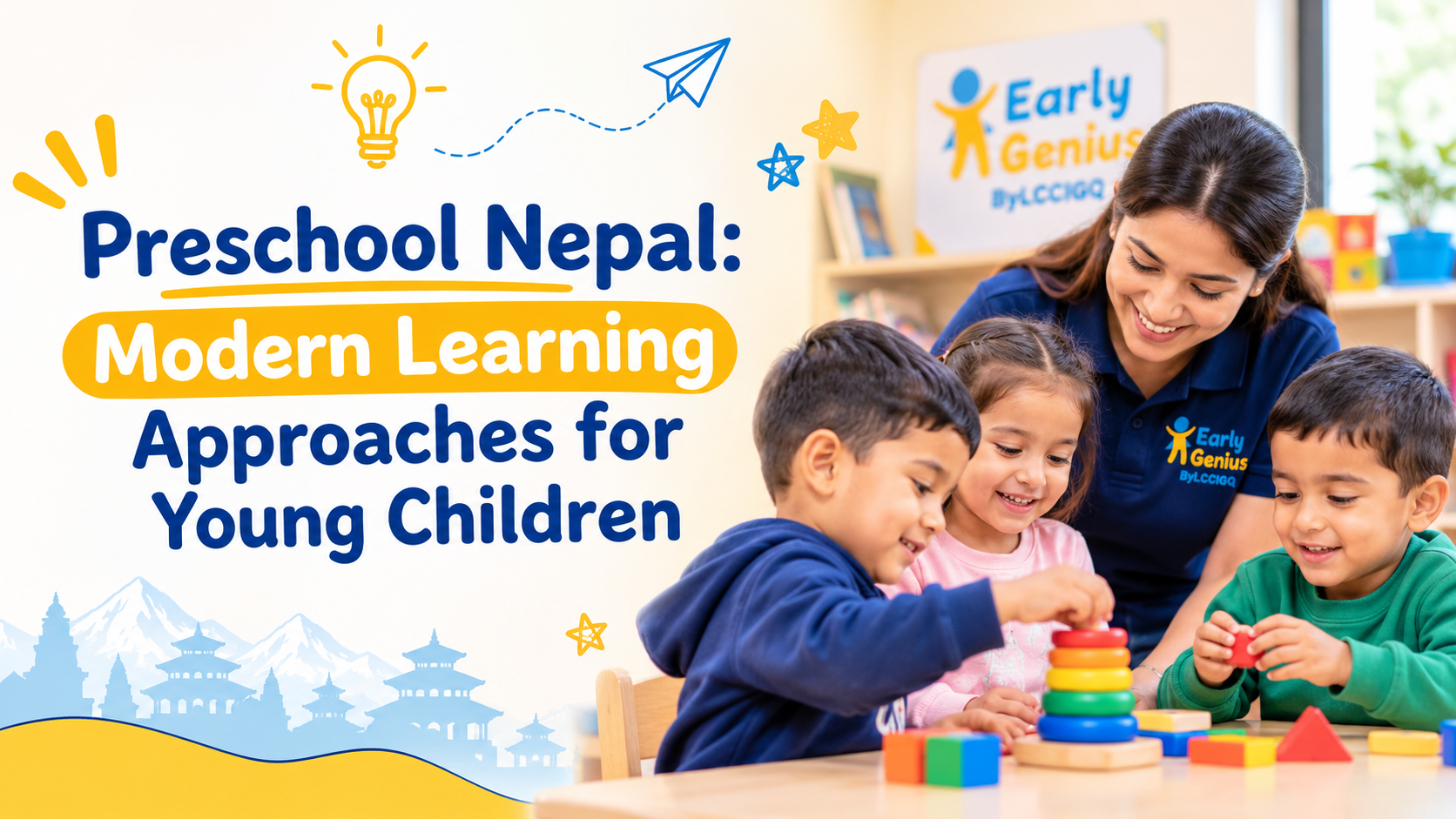
In the classrooms of Preschool Nepal, teachers can use blocks to teach children about shapes and numbers, role-play activities to develop their language skills, and matching games to enhance their memory and ability to observe.
Playing gives children the room to share resources, adhere to basic orders, play with others, and cooperate with their schoolmates; teachers supervise these activities in order that children may have fun while meeting specified educational objectives.
2. Learning with Activities.
Learning with the help of activities helps children comprehend concepts through performing tasks themselves. This creates a link between the educational process at school and real-life endeavors.
Teachers can offer children different types of activity, such as:
- Counting leaves, blocks, or other objects found in the classroom
- Sorting objects according to their color, size, or shape
- Doing painting, drawing, or creating origami
- Planting seeds and monitoring the processes of growing
- Singing songs and memorizing poems
- Doing puzzles and developing problem-solving skills
Such activities stimulate development of curiosity, as well as involvement into learning process.
3. Content-Centered Education
Content-centered education indicates the interconnection among various subjects under one single theme. For instance, instead of studying individual concepts separately teachers may use subjects like animals, food, weather, transportation, nature, and festivals as an umbrella theme.
The example of the theme of plants would involve activities such as drawing flowers, learning new vocabulary, counting leaves, listening to stories about gardens, and planting the seeds. Children learn different aspects of language, early mathematics, creativity, and science under one umbrella theme.
Use of this method may be particularly relevant in the context of Nepal since lessons could include favorite food, regional animals, life in the community, celebrations, as well as nature surrounding the school.
4. Arts, music, and movement
Creative arts, music and movement play an essential role in early childhood education, allowing children to express their ideas and feelings in various ways.
Drawing, painting, singing, dancing and doing simple crafts support different aspects of a child's development including creativity, coordination and listening skills.
Action songs can help teachers teach children about body parts, colors, numbers and common routines.
Artistic practices can help children articulate their projects and explain their thoughts in their own words.
An ideal preschool program does not forget to give kids the chances to be engaged in creative activities, besides teaching them the language and mathematical skills.
5. Inquiry-Based Learning.
Inquiry-based learning motivates children to ask questions and find answers through exploration with assistance. Children are curious by nature, so teachers can utilize this trait when introducing new concepts.
If a child inquires why it rains, the teacher can explain the concept of clouds, show images of the water cycle and even illustrate the process of rain making. It allows for observation as well as the opportunity to express opinions and ask more questions.
Inquiry based learning approach promotes critical thinking, observation, communication and problem-solving because it shows that learning means finding the truth instead of memorizing it.
Teachers need to guide students based on their specific developmental level and to give children enough time to explore the subject in the appropriate manner.
6. Technology-Assisted Learning
Technology can be beneficial to preschool education, but only if carefully used for proper educational goals. Tools such as digital stories, interactive pictures, educational video clips, and simple visualized exercises can help children to learn new things.
For instance, an animated story can effectively prepare children for a topic to be followed by the relevant drawing or hands-on tasks. Also, materials with augmented reality can make some learning exercises more engaging.
At the same time, it is worth nothing that technology should never replace physical play, outdoor activities, communication, and interaction with teachers and peers. The use of screens needs to adhere to age regulations, be reasonable, limited, and supervised.
The optimal way is combining digital resources with printed materials, practical activities, discussions, and creativity.
7. Social and Emotional Learning
Educational children can be considered in a certain way.is not just about the education of letters and numbers. Children must also be able to communicate with themselves, express their emotions and feelings and that is in particular. Teachers can reinforce these skills by using group games during classes, or telling stories, and allowing children to understand the expressive power of the words they use and making it easier to form interpersonal relations. All the children have to do is to learn all about the sharing and taking turns at the same time.
Using school learning, one can make the learning process easier in a classroom environment where teachers do respect the children and various ideas that they may express themselves.
8. Personalized Learning and Continuous Monitoring
Every child develops at his or her own pace. A few children are willing to speak in public, while others are more comfortable with drawing or watching things around them. The modern preschool teacher is aware of that and provides children with all types of opportunities.
Teachers can watch how children participate, develop language skills, solve problems, coordinate movements, and interact socially. Writing simple progress notes accompanied with age-appropriate activities can be of help in discovering the strong and weak sides of each young learner.
Regular contact with parents allows providing support to kids both at home and in classroom.
How Early Genius Helps in Contemporary Early Education
Early Genius presents the early years curriculum and learning tools aiming at providing help to children, educators, and parents alike. The program is created in partnership with Oxford Advantage and encompasses curriculum material, playful learning approach, digital resources, and teacher training.
Firstly, it has thematic learning material, resources for students, artistic activities, and selected AR and 3D educational activities that allow teachers to create interesting lessons and promote students’ cognitive, linguistic, social, emotional, physical, and creative skills.
Secondly, teacher education and program assistance are equally important for a successful early learning process. When teachers understand how to use all the educational material and adjust the activities to their students’ needs, they can make the learning process more purposeful and successful.
If schools want to enhance the early years program, they can turn to Early Genius and find out more about its services and products.
Ways in Which Parents Can Help Preschool Children Learn at Home
Parents have an important part to play in supporting children's efforts to reinforce what they learn from school. Learning does not have to be expensive, because simple everyday activities can do the job.
The following are some ideas for parents on what they can do at home:
- Reading picture books and asking questions about the plot
- Counting fruits, toys, steps and objects
- Encouraging drawing, coloring, singing and pretending
- Letting children do some easy household chores
- Sharing information about plants, animals, weather and the places in the neighborhood
- Pushing children to share their ideas about their feelings and inquire about things they are curious about
- Getting in touch with the teachers to find out how well the children are doing at school.
These activities allow children to incorporate learning into their daily lives and gain self-confidence by interacting in an effective manner.
Conclusion
Contemporary pre-school education is all about making kids learn things on their own through exploration, creativity, communication, and practical experience. At school, children have many opportunities to learn through play, enjoy activities based around a theme, practice inquiry learning, engage in art, study new technologies, and develop their emotional intelligence.
When running preschool programmes in Nepal, educators should focus on providing effective learning conditions where children can gain essential skills necessary for developing their creativity, independence, and confidence.
Early Genius ensures success in achieving this aim with the help of its preschool programme and integrated learning solutions dedicated to schools and educators.
FAQ
1. What contemporary methods exist in preschool learning nowadays?
Contemporary methods imply such learning methods like learning through games and activities, course-based education, inquiry-based discovery, arts and crafts, and the use of age-appropriate digital tools. All of them contribute to child learning by involvement.
2. Why is learning through games so important for preschool institutions in Nepal?
Games-based education allows children to interact, communicate, and make simple problem-solving and interaction. It makes learning exciting while bringing in various aspects of development.
3. What are the ways in which technology influences preschool education?
Technology can introduce many ideas by means of digital stories and pictures, as well as some definite AR learning tools. However, technology should never substitute reading, being physically active, using hands-on methods or face-to-face communication.
4. What do schools need to pay attention to when looking for preschool curriculum?
They should understand age-appropriate goals of learning, activities that should be included into the educational process, teaching resources that can be helpful in the process, monitoring of progress, as well as preparation of teachers and involvement of parents.